
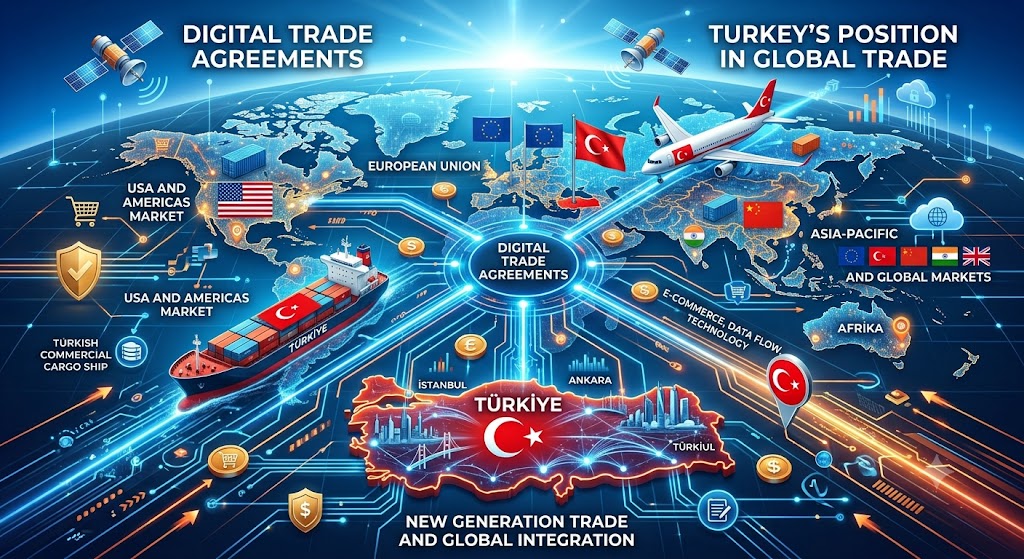
The rapid growth of the digital economy has transformed the way countries trade goods and services. Digital technologies have enabled businesses to reach international markets more easily, making e-commerce, digital services, and cross-border data flows essential components of global trade. As a result, digital trade agreements have emerged as an important tool for regulating online commerce, protecting consumer rights, and promoting innovation. For Türkiye, adapting to this new trade environment presents both significant opportunities and important challenges.
Digital trade agreements are international agreements that establish rules for electronic commerce, digital payments, cybersecurity, intellectual property, data protection, and the movement of digital information across borders. Unlike traditional trade agreements that mainly focus on tariffs and physical goods, digital trade agreements address issues such as paperless trading, electronic signatures, online consumer protection, and restrictions on data localization. These agreements aim to reduce barriers to digital business while creating a secure and predictable environment for companies and consumers.
Türkiye has become an increasingly important player in international trade due to its strategic geographical location between Europe, Asia, and the Middle East. As digital transformation accelerates worldwide, Türkiye has recognized the need to modernize its trade policies and strengthen its digital economy. Government initiatives supporting digital infrastructure, fintech development, and e-government services demonstrate the country’s commitment to becoming a competitive participant in global digital commerce.
One of Türkiye’s greatest advantages is its dynamic and young population, which has rapidly adopted digital technologies. The expansion of online marketplaces, mobile banking, and digital entrepreneurship has created new opportunities for Turkish businesses to access international customers. Small and medium-sized enterprises (SMEs), which form the backbone of Türkiye’s economy, can particularly benefit from digital trade by reducing operational costs and expanding beyond domestic markets through e-commerce platforms.
However, Türkiye also faces several challenges in fully integrating into the global digital trading system. One of the primary issues is regulatory alignment with international standards, particularly those established by the European Union. Since the EU is Türkiye’s largest trading partner, harmonizing regulations related to data protection, cybersecurity, and digital services is essential for maintaining market access and attracting foreign investment. Compliance with international digital trade standards can also improve trust among global business partners.
Another important challenge involves data governance and cybersecurity. As cross-border data flows become increasingly valuable for international business, governments must balance economic openness with national security and personal privacy. Türkiye continues to develop legal frameworks that protect sensitive information while encouraging innovation and international cooperation.
Participation in modern digital trade agreements could further strengthen Türkiye’s position in global commerce. Such agreements would provide greater legal certainty for businesses, facilitate digital exports, encourage foreign direct investment, and support technological innovation. Furthermore, closer cooperation with international organizations and regional trade partners could enhance Türkiye’s competitiveness in emerging sectors such as artificial intelligence, cloud computing, and digital financial services.
In conclusion, digital trade agreements are reshaping the global trading landscape by establishing common rules for the digital economy. Türkiye possesses considerable potential to become a regional leader in digital commerce due to its strategic location, growing digital infrastructure, and entrepreneurial population. Nevertheless, achieving this goal will require continued regulatory reforms, investment in digital technologies, and stronger international cooperation. By embracing digital trade and aligning with global standards, Türkiye can expand its role in international commerce and secure sustainable economic growth in the digital age.
Partner with us. CONEXIO helps businesses navigate international regulations, digital compliance, and market entry strategies in Türkiye and beyond.