
Why Turkish Investment in the Balkans Matters
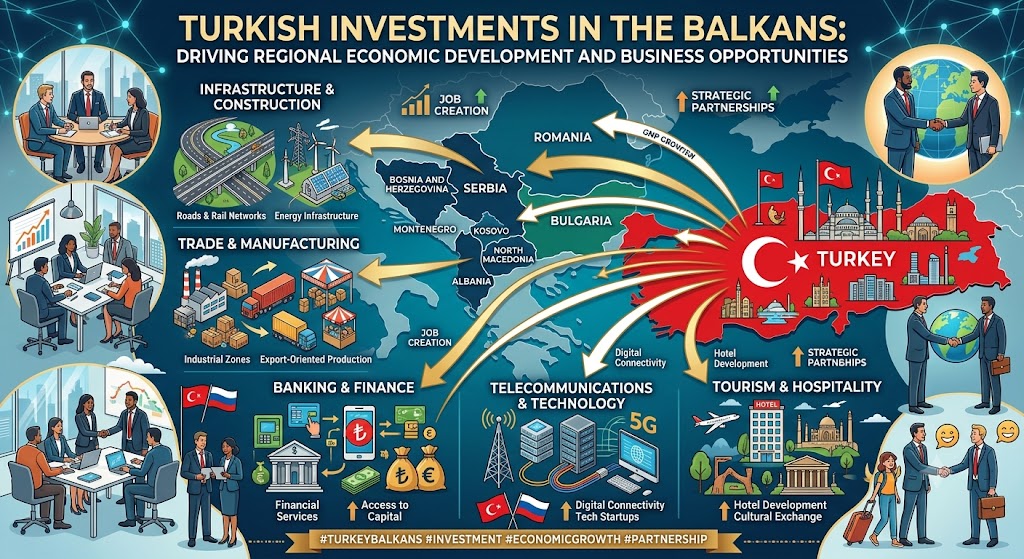
Over the past two decades, Turkish investment in the Balkans has become one of the most significant drivers of regional economic development. Supported by geographic proximity, historical ties, expanding trade relations, and increasing political cooperation, Türkiye has strengthened its economic presence across Southeast Europe through investments in infrastructure, manufacturing, banking, renewable energy, tourism, logistics, and real estate.
For businesses considering expansion into Southeast Europe, understanding the impact of Turkish foreign direct investment (FDI) provides valuable insights into emerging market opportunities, regional supply chains, and long-term economic trends. As the Balkans continue their economic integration with the European Union, Turkish investors are playing an increasingly strategic role in shaping the region’s future.
The Growing Role of Turkish Foreign Direct Investment
Foreign direct investment is widely recognized as one of the strongest catalysts for sustainable economic growth. Beyond injecting capital, FDI stimulates job creation, transfers technology, improves infrastructure, enhances productivity, and strengthens institutional development.
Türkiye has become one of the leading investors in countries including:
- Albania
- Bosnia and Herzegovina
- Serbia
- Kosovo
- North Macedonia
- Montenegro
Across these markets, Turkish companies have invested in sectors ranging from industrial manufacturing and financial services to transportation, healthcare, telecommunications, and renewable energy. This diversification has contributed to greater regional resilience and deeper economic integration.
Employment Creation and Local Economic Growth
One of the most visible impacts of Turkish investment is employment generation. Manufacturing facilities, construction projects, retail operations, and service-sector investments have created thousands of direct and indirect jobs throughout the Balkans.
These investments generate economic benefits that extend well beyond the initial project. Local suppliers, logistics providers, engineering firms, and small businesses frequently become part of Turkish companies’ supply chains, producing a multiplier effect across local economies.
In regions where unemployment remains above the European average, sustained foreign investment helps improve household incomes, stimulate domestic consumption, and strengthen long-term economic stability.
Infrastructure Development as a Competitive Advantage
Infrastructure has become one of the defining areas of Turkish economic engagement in Southeast Europe.
Turkish construction and engineering companies have participated in major projects involving:
- highways
- airports
- bridges
- rail networks
- commercial developments
- public infrastructure
Modern transport infrastructure reduces logistics costs, facilitates cross-border trade, and improves regional connectivity. Better infrastructure also increases the attractiveness of Balkan countries for additional international investors, creating a virtuous cycle of investment and economic development.
Technology Transfer and Workforce Development
Beyond financial investment, Turkish companies contribute valuable expertise through technology transfer and human capital development.
Modern production techniques, digital manufacturing systems, quality management standards, and workforce training programs help increase productivity across local industries.
Employees acquire technical capabilities and management experience aligned with international business practices, while domestic firms gain exposure to global operational standards. These knowledge transfers improve competitiveness and support innovation throughout the regional economy.
Strengthening Regional Trade and Supply Chains
Türkiye occupies a strategic position connecting European, Middle Eastern, Central Asian, and Mediterranean markets.
As Turkish companies continue investing in logistics, transportation infrastructure, manufacturing, and distribution centers, Balkan economies become increasingly integrated into international supply chains.
Growing commercial ties produce several long-term benefits:
- increased exports
- diversified trade routes
- improved regional logistics
- enhanced supply chain resilience
- stronger cross-border business cooperation
These developments have become particularly important as European companies seek to diversify production and reduce supply chain risks.
Investment Challenges in the Balkans
Despite considerable progress, investors continue to face several structural challenges.
These include:
- regulatory uncertainty
- bureaucratic complexity
- inconsistent legal frameworks
- political instability in certain markets
- inflationary pressures
- exchange-rate volatility
Addressing these issues requires continued reforms focused on transparency, judicial efficiency, digital public administration, infrastructure modernization, and workforce development.
Countries that successfully improve their investment climate are likely to attract greater volumes of international capital over the coming decade.
Future Opportunities for Turkish Investors
Several high-growth sectors are expected to drive the next phase of Turkish investment in the Balkans.
Key opportunities include:
- renewable energy
- solar and wind power
- digital transformation
- artificial intelligence
- financial technology (FinTech)
- smart logistics
- advanced manufacturing
- industrial automation
- healthcare infrastructure
- data centers
The accelerating green transition, combined with increasing digitalization across Europe, positions the Balkans as an attractive destination for export-oriented production and regional distribution.
Türkiye’s experience in industrial development, infrastructure delivery, and international trade provides a strong foundation for expanding cooperation in these strategic sectors.
Why the Balkans Remain Attractive for International Investors
Several structural advantages continue to enhance the region’s investment appeal:
- strategic location between Europe and Asia
- competitive labor costs
- improving transport infrastructure
- expanding access to EU markets
- growing consumer demand
- increasing regional economic integration
For companies seeking nearshoring opportunities, supply chain diversification, or expansion into emerging European markets, the Balkans offer an increasingly compelling business environment.
Conclusion
Turkish investment has become a significant driver of economic transformation across the Balkans. Through infrastructure development, job creation, technology transfer, industrial modernization, and stronger regional trade, Turkish companies are contributing to sustainable growth and enhanced competitiveness throughout Southeast Europe.
While regulatory and political challenges remain, ongoing reforms and expanding economic cooperation continue to improve the region’s investment outlook.For businesses evaluating expansion into Southeast Europe, understanding the evolving relationship between Türkiye and the Balkans is increasingly important. As global supply chains continue to shift and regional connectivity strengthens, Turkish investment is expected to remain a central force shaping the Balkans’ economic future