
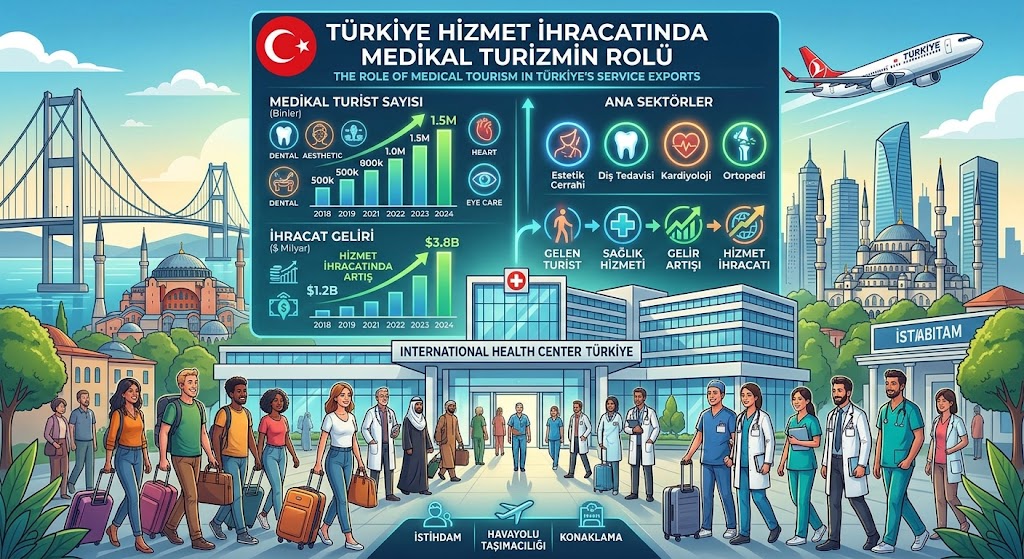
Medical tourism is a cornerstone of Türkiye’s modern service economy. By combining advanced medical facilities, certified professionals, and competitive pricing, the country has become a top-tier international healthcare hub. Today, health tourism is no longer just a medical activity. It is a critical driver of service export revenues and foreign currency inflows for the Turkish economy.
Türkiye’s Health Service Export Growth
Türkiye’s medical tourism sector has experienced massive expansion over the last decade. Data from the Turkish Ministry of Trade highlights this rapid trajectory:
Patient Volume: International health tourist arrivals grew sixfold between 2012 and 2024, reaching 1.5 million visitors.
Revenue Inflow: Health service export revenues grew fourfold, reaching $3 billion in 2024.
Macro Impact: In 2024, Türkiye’s total service exports hit $117.2 billion, creating a $61.4 billion service trade surplus.
While health tourism is a specific segment of total service exports, its high-profit margins and high-value revenue generation make it economically vital.
Why International Patients Choose Türkiye
Several strategic advantages position Türkiye as a leading destination for global healthcare consumers:
- Cost Efficiency: High-quality medical procedures cost significantly less than in Western Europe or North America.
- Strategic Location: Positioned at the crossroads of Europe, Asia, and the Middle East, Istanbul serves as a massive, accessible global transport hub.
- Infrastructure: Massive public and private investments have yielded world-class, internationally accredited hospitals.
- State Support: National branding initiatives like the “Heal in Türkiye” platform actively boost global visibility.
The Multiplier Effect on the Turkish Economy
The economic footprint of medical tourism extends far past hospital walls, creating a powerful multiplier effect across multiple service sectors:
- Hospitality & Lodging: Patients and their companions require extended stays in hotels and rentals.
- Transport & Logistics: Increased demand for flights, airport transfers, and local car rentals.
- Support Services: Higher employment for translators, medical travel agencies, and legal advisors.
- Foreign Currency Inflow: Unlike local spending, international patient revenues bring direct foreign currency into the economy, strengthening the country’s service balance.
Future Opportunities in Turkish Health Tourism
To sustain this momentum, the sector is moving beyond cosmetic treatments into complex medical fields.
Specialized Medical Fields
While hair transplants, dental care, and plastic surgery remain highly popular, Türkiye is expanding its market share in complex treatments:
- Oncology and cancer care
- Cardiovascular surgeries
- Advanced orthopedics
- Fertility and IVF services
- Specialized rehabilitation
Patient Experience & Digital Health
Future market capture relies heavily on trust. The industry is prioritizing digital health integration, transparent pricing models, clear multilingual communication, and structured post-treatment follow-up care.
Government Incentives
The Turkish government continues to offer robust financial incentives. Healthcare providers and health tourism agencies receive direct support for global marketing, international accreditation, and overseas brand building.
Conclusion
Medical tourism is a highly valuable component of Türkiye’s service export portfolio. Generating $3 billion in 2024 from 1.5 million patients, the sector successfully drives foreign currency inflows and cross-industry employment. Moving forward, Türkiye’s focus is shifting from pure volume to premium quality—exporting medical expertise and building long-term global trust.