
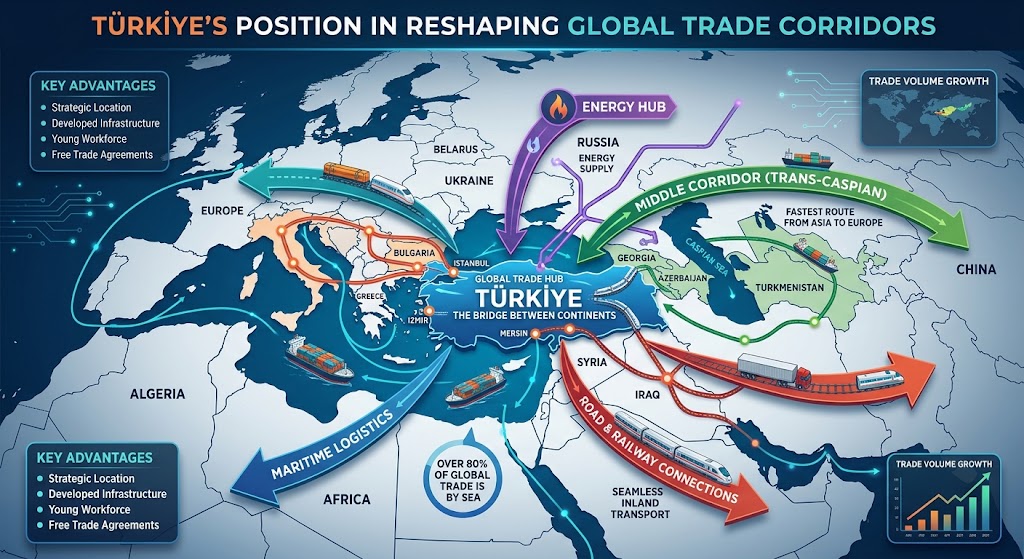
Global trade is undergoing a major structural transformation. Rising geopolitical tensions, frequent disruptions to traditional maritime shipping routes, and an urgent corporate need for supply chain resilience are forcing businesses and governments to diversify their logistics networks.
In this rapidly changing environment, Türkiye is emerging as a critical strategic player in the development of new global trade corridors.
Located at the crossroads of Europe, Asia, the Middle East, and the Caucasus, the nation has long served as a geographical intersection between major consumer and manufacturing markets. Today, its role is fundamentally evolving. Backed by massive investments in transport infrastructure, railways, deep-water ports, and international networks, Türkiye is moving beyond a simple transit country to become a dominant regional logistics hub.
The Middle Corridor: Connecting Asia and Europe
One of the most vital developments shaping Türkiye’s role in international commerce is the Middle Corridor, formally known as the Trans-Caspian International Transport Route (TITR). This multimodal network combines rail, road, and maritime transportation to provide a faster, highly competitive alternative route for moving goods between Asian manufacturing centers and European consumer markets.
Türkiye plays an indispensable role in optimizing this network’s efficiency:
- Infrastructure Integration: The Baku-Tbilisi-Kars (BTK) railway directly connects Caspian transport routes to the Turkish rail network.
- Subsea Connectivity: The Marmaray rail tunnel under the Bosporus Strait allows seamless, uninterrupted freight transit from Asia directly into Europe.
- Route Diversification: As multinational corporations prioritize supply chain security, the Middle Corridor offers a reliable bypass to traditional Northern and Southern routes.
The Development Road Project: A New North-South Trade Axis
Türkiye’s strategic expansion extends beyond east-west connectivity. The upcoming Development Road project is set to add a powerful north-south axis to the country’s logistical portfolio.
This ambitious initiative aims to link Iraq’s multi-billion-dollar Grand Al-Faw Port on the Persian Gulf directly to the Turkish border via a 1,200-kilometer network of high-speed railways and modern highways. From the border, freight integrates into the domestic network and flows directly into Europe.
By linking the energy-rich Gulf region and Middle Eastern markets with Europe, the Development Road establishes a highly competitive shipping alternative. For global enterprises, the convergence of the Middle Corridor and the Development Road means Türkiye is no longer dependent on a single route; it is the ultimate intersection point for multiple high-volume global trade corridors.
Beyond Asphalt and Iron: Infrastructure and Digitalization
Physical infrastructure is only half of the modern logistics equation. To remain competitive, modern trade routes must operate as intelligent, data-driven ecosystems. For Türkiye, maximizing its geographic advantage requires deep investments in digital infrastructure and administrative optimization:
- Automated Customs & Smart Borders: Transitioning to fully digital customs clearance and unified international documentation significantly reduces wait times at border crossings.
- Real-Time Supply Chain Visibility: Implementing IoT tracking and blockchain-enabled data sharing allows logistics companies to track cargo coordinates and environmental conditions in real time.
- Interconnected Intermodal Hubs: Building smart logistics centers where rail, air, and sea freight synchronize seamlessly lowers overall operational costs.
A successful trade corridor is more than lines on a map. It requires strict digital alignment between international customs authorities, terminal operators, and private logistics enterprises.
From a Geographical Bridge to a Global Logistics Hub
Historically, market analysts labeled Türkiye as a “bridge” between the East and the West. While accurate, this term fails to capture the country’s proactive future.
Instead of merely watching goods pass through its territory, Türkiye is positioning itself to handle value-added logistics: storing, processing, sorting, and distributing freight directly to surrounding markets in Europe, Central Asia, and North Africa. Its proximity to 1.3 billion consumers within a four-hour flight radius offers an unparalleled platform for companies restructuring their nearshoring and friendshoring operations.
The coming decade will determine the speed of this transformation. Continuous execution of transport projects, regional diplomatic cooperation, and regulatory trade facilitation will turn geographic location into permanent economic value.
Strategic Implications for Global Business
For international corporations looking to future-proof their supply chains against future macroeconomic shocks, Türkiye’s infrastructure boom offers concrete advantages:
- Reduced Lead Times: Shorter transit windows compared to traditional sea voyages through congested chokepoints.
- Risk Mitigation: Alternative routing buffers businesses against localized geopolitical conflicts or maritime shutdowns.
- Sustainability Targets: Intermodal rail networks offer lower carbon emissions per ton-mile compared to long-haul air or road freight.
How Conexio Consulting Can Help
Navigating international trade laws, customs frameworks, and cross-border logistics across these emerging corridors requires local expertise and strategic foresight. At Conexio Consulting, we help businesses capitalize on Türkiye’s resilient operations and comercial activities at the center of global trade.